

26 Jun Leaning In: Wealth, Vulnerability, and the Therapeutic Relationship
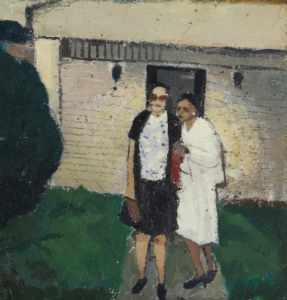 I recently acquired this painting by Kurt Knobelsdorf for my personal collection. In it, two women of color stand close together in front of a modest building. Their faces are indistinct, but their bodies lean into one another in a way that feels both tender and weary—two figures quite literally holding each other up. The mood is quiet, almost melancholy, and yet deeply connected.
I was drawn to the piece because it captures, in a single image, what I see every day in my clinical work at the intersection of #wealth, #identity, and #mentalhealth: the longing for support and the fear of being fully seen.
For patients who live in an identity of wealth, trust is rarely simple. Many of my patients occupy social worlds where relationships are shadowed by questions: Do you care about me, or about my money, my access, my family name? If I reveal the messiness of my marriage, the struggles of my children, my shame around substances or sex—will that information be used against me, repeated, or judged?
When you are accustomed to being viewed as a resource rather than a person, vulnerability can feel dangerous.
Over time, these repeated injuries erode the capacity to trust. Wealthy patients learn to split themselves. There is the public self that performs competence and control. There is the family self that manages expectations, legacy, and sometimes secrets. And then there is the private self that is lonely, frightened, or exhausted—but rarely invited into the room. By the time they arrive in treatment, their external lives may look enviable, but internally they often feel like Knobelsdorf’s figures: present, proximate, but not fully visible.
This is where the therapeutic alliance becomes not just a vehicle for treatment, but the treatment itself.
When our patients of wealth experience a relationship that is boundaried, confidential, and grounded in culturally humble and culturally competent care—not envy, not seduction, not moral judgment—something profound can happen. The work is no longer only about insight or symptom reduction. It becomes about testing, slowly and repeatedly, the question: “Can I risk leaning my weight on this person and still be safe?”
In my practice, a few elements in establishing this therapeutic frame are non‑negotiable:
- An explicit commitment to confidentiality and clear boundaries, discussed openly rather than assumed.
- Cultural humility around wealth, race, gender, and power, recognizing that extreme privilege and profound vulnerability can coexist in the same person.
- A willingness to name the power dynamics in the room, including those generated by money, status, and social identity.
- Patience with the time it takes for someone whose life has been transactional to believe that this relationship is not for sale.
When those conditions are present, the therapy room can become a place where patients of wealth begin to do what the women in Knobelsdorf’s painting do for each other: lean in and on each other. They risk telling the truth about their inner lives. They allow themselves to be held emotionally, not for what they can provide, but for who they are. The blurred edges of their identities—race, class, gender, pain—come into clearer focus without being weaponized.
The painting now hangs in my office where I see it every day. For me, it is a reminder that mental health is not achieved through isolation, performance, or financial engineering, but through relationships that are rooted in vulnerability and support. As clinicians, especially when working with patients of wealth, our task is not to be impressed or intimidated. Our task is to become a relationship sturdy enough for another human being to lean on.
And for those living inside an identity of wealth: you deserve a space where your story, not your balance sheet, is what matters—and where you no longer have to stand alone.
Sorry, the comment form is closed at this time.